




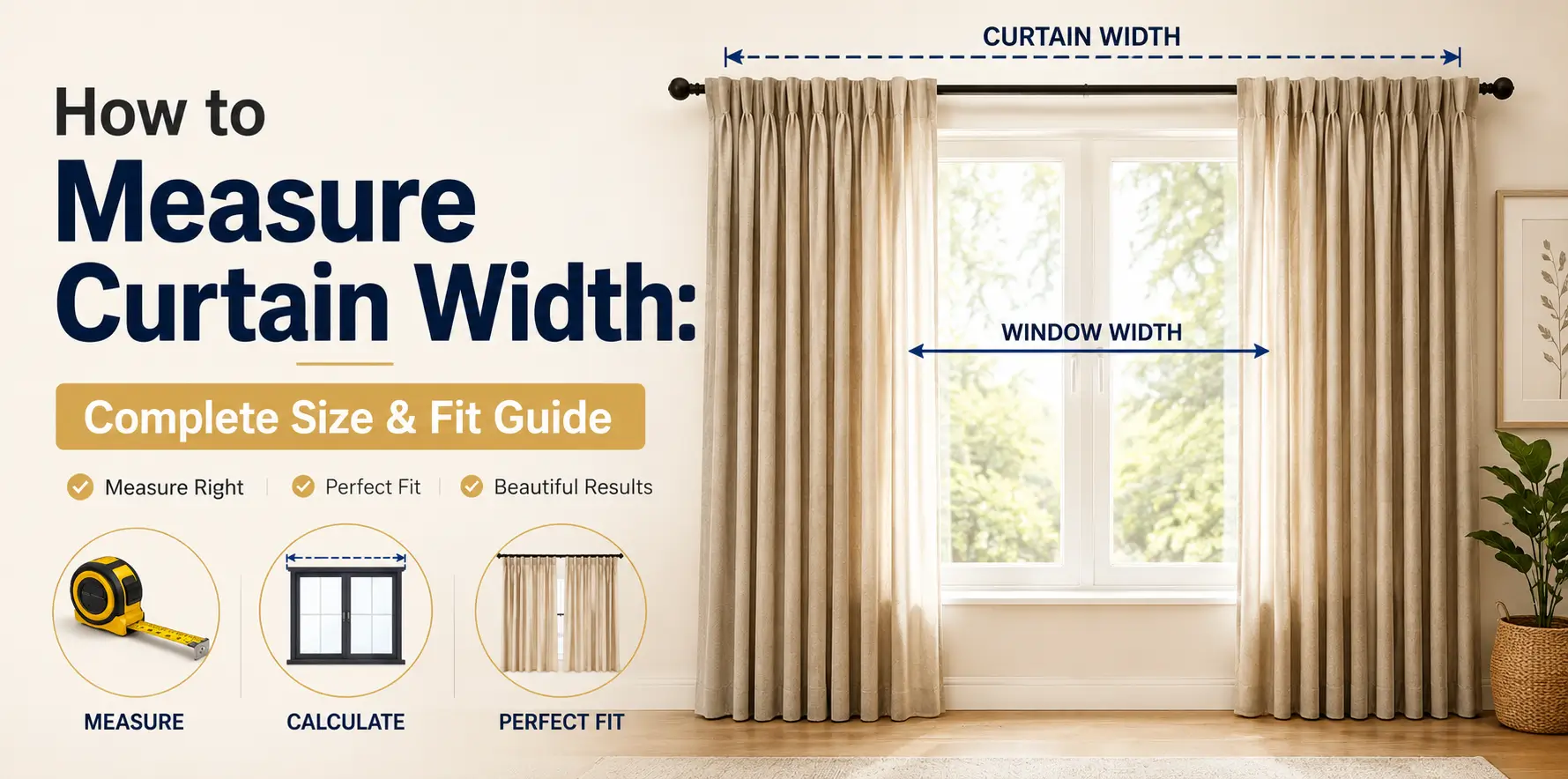
How to Measure Curtain Width: Complete Size & Fit Guide
Getting the right curtain size sounds simple until you actually have to measure a window, door, stage, or large opening. Should you measure the window or the curtain track? How much extra fabric do you need? And what happens when you are ordering a sound control or theater curtain instead of a regular window curtain?
These questions matter because the wrong measurements can leave you with gaps, curtains that look too flat, or fabric that hangs too high or low.
This curtain size guide will walk you through the measurements that matter, with simple examples you can follow. We will also cover a few things to keep in mind when measuring acoustic, sound control, and theater curtains.
What you need before you start measuring
You do not need any special tools. A few simple things are enough:
A steel measuring tape
A pen and paper, or your phone to note the numbers
A step stool or ladder if the window is high
Your curtain rod or track, if it is already installed
Measure in inches if you are buying curtains that use inch-based sizes. Write down every measurement as you go. It is easy to forget whether you measured 68 or 86 inches later.
One important thing to remember: measure the rod or track, not just the window. Your curtains need to work with the space where they will actually hang.
What measurements do you need before you start?
Before picking up your measuring tape, decide how and where the curtain will be installed.
For a regular window, you will usually need:
The window width
The curtain rod or track width
The height from the hanging point to the bottom of the curtain
The amount of fullness you want
For larger projects, such as a theater, auditorium, stage, or sound control installation, you may also need to measure the complete opening, track length, side coverage, and floor-to-ceiling height.
Start with the curtain rod or track
If you are searching for how to measure curtain width, start with the curtain rod or track rather than the glass area of the window.
If the rod is already installed, measure its usable width from one end to the other. If you are installing a new rod, decide how far you want it to extend beyond the window on both sides.
For example, suppose your window is 60 inches wide. You want the rod to extend 6 inches beyond each side.
Your rod width would be: 60 + 6 + 6 = 72 inches
That 72-inch measurement is now the starting point for calculating your curtain width. But there is another part people often miss: curtains need extra fabric to create folds.
How much extra curtain fabric do you need?
Decide how full you want your curtains to look. Curtains need extra fabric because they are not meant to hang completely flat. The extra material creates the folds and gathers you see when the curtains are closed.
A simple guide is:
1.5 times the rod width: It will be light and have a simple fullness
2 times the rod width: A fuller everyday look
2.5 times the rod width: A rich, fuller appearance
Let's say your rod is 72 inches wide.
With 1.5× fullness:
72 × 1.5 = 108 inches
With 2× fullness:
72 × 2 = 144 inches
So, if you want a fuller look, you need about 144 inches of total curtain fabric.
If you are using two curtain panels, you can divide that total between them. In this example, two panels of about 72 inches each would give you 144 inches of total width.
How to measure curtain length
Once you have the width, measure the length. The important part here is knowing where to start measuring.
Do not automatically measure from the top of the window. Start from the point where the curtain will actually hang. This might be the rod, track, hooks, or another hanging point.
Then measure down to where you want the curtain to finish.
You may want the curtain to:
End at the windowsill
Fall below the windowsill
Stop just above the floor
Lightly touch the floor
Extend onto the floor for a more decorative look
For a floor-length curtain, measure from the hanging point all the way to the floor.
If the curtain will hang from a track, measure from the point where the curtain hooks will sit. This small detail can make a noticeable difference in the finished length.
How do you know what size curtains to buy?
If you are asking, how do I know what size curtains to buy, you can make the decision using two main measurements: the total curtain width and the finished length.
Let's use a simple example.
Your curtain track is 72 inches wide.
You want 2× fullness:
72 × 2 = 144 inches
You want two curtain panels:
144 ÷ 2 = 72 inches
So you would look for two panels that are about 72 inches wide each.
Now suppose the distance from the curtain's hanging point to the floor is 84 inches. Your curtain length would be around 84 inches, depending on how you want the bottom to sit.
One thing you should always check before ordering is whether the listed curtain width is for one panel or a pair. Product sizes are not always shown in the same way.
Does curtain fullness change the size you need?
Imagine two curtains covering the same 72-inch-wide track. One uses 1.5× fullness and the other uses 2× fullness. They will not have the same amount of fabric.
The 1.5× curtain needs about 108 inches of total fabric, while the 2× curtain needs about 144 inches.
This is why simply matching your curtain width to your window width often does not work.
The type of curtain matters too. A pleated curtain, for example, may be measured and made differently from a simple panel.
When should you ask a curtain specialist for help?
For a standard window, measuring your own curtains is usually straightforward.
But professional guidance can be helpful when the project involves custom dimensions, very wide openings, acoustic or sound control curtains, theater curtains, motorized tracks, or unusual room layouts.
Saaria offers a variety of curtain and track systems such as sound control curtains, acoustic curtains, stage curtains, theater curtains, auditorium curtains, and both motorized and manual tracks.
In case there is doubt regarding the measurement, it is always advisable to inquire beforehand rather than wait until the curtains are ready. The opening measurements, installation and the type of curtain that is needed can be provided for confirmation of the measurements.